Every Monday morning my inbox holds at least two emails that open the same way: "We are looking for a reliable badminton shuttlecock supplier in China. Please send your price list." I answer every one, and I always ask the same question back: which of the three kinds of "supplier" are you actually looking for?
Because a shuttlecock supplier is not one business. It is at least three, sitting at different points along the same container, and from the outside they look identical — the same product photos, the same "OEM/ODM welcome", the same confident showroom answers. What separates them is who actually touches your feathers, and how much of your money stays between you and that person.
Most buyers compare prices first and structure second. That's backwards. Get the structure right and the price conversation is short; get it wrong and you will pay for it in every quote, every reorder and every container for the next two years. I run a feather shuttlecock factory in Wuhu, Anhui, and this guide is the conversation I wish every buyer could have before they wire a deposit.
The Three Businesses That Call Themselves a Shuttlecock Supplier
Open any B2B platform, search shuttlecock, and all three types appear side by side using the same vocabulary. Here is the map:
| Supplier type | Who actually makes your balls | Where their margin sits |
|---|---|---|
| Factory (OEM manufacturer) | Their own line — feather sorting, cork turning, gluing, flight testing | The FOB price on the quotation |
| Trading company | A factory you will never speak to | Typically 10–20% added on top of the factory price |
| Sourcing agent | Whoever they place this month's order with | 5–10% commission, sometimes folded quietly into the quote |
None of this is exactly hidden. Some made-in-china listings state it in the same line — one Chengdu supplier I checked while writing this lists its business type as "Manufacturer/Factory & Trading Company" in a single field. The platforms know buyers want factories, so even the hybrids market themselves as manufacturers. The label does the marketing; the structure stays quiet.
So how do you tell them apart? Not from the logo or the banner. From ten minutes of specific questions:
- Ask for a live video walk from the production floor — not the showroom. A factory can point a phone at the feather grading tables at nine in the morning their time. A middleman will offer polished photos, a showroom tour, or a "network problem".
- Ask a cork question on the spot: full natural or three-layer composite, what density, what origin. A factory answers in one sentence. A layer in between says "I will check with production" — which is the answer that defines their life.
- Ask about tubes. If you will need printed tubes anyway, a factory that prints in-house answers instantly with colour counts and plate costs. A ball trader suddenly reveals a second supplier you now have to manage.
- Ask for capacity in dozens. Real factories state real numbers without checking — annual output in dozens, headcount on the sorting line, how many grades they sort under their own roof. The largest integrated mills in the feather clusters run into the millions of dozens a year; a partner for a growing brand does not need to be anywhere near that scale. What it does need is to answer in the same units: dozens per year, staff on the line, grades sorted in-house. A company that cannot state capacity in dozens is not a factory.
If you want the deeper version of the factory check — the full audit checklist with the fourteen and fifteen-point lists we use — here is the walk-through →
What Each Layer Adds to Your Cost: the Real Math
Let me give you real numbers. Factory-direct FOB prices per dozen in 2026, for reference: Tournament A++ goose runs $24–32, Match A+ runs $18–24, Club A runs $12–18, and Training B runs $7–12. Nearly every honest quote lands inside those bands. Now watch what happens to a Club A program at $14 a dozen once a layer sits between you and the production line.
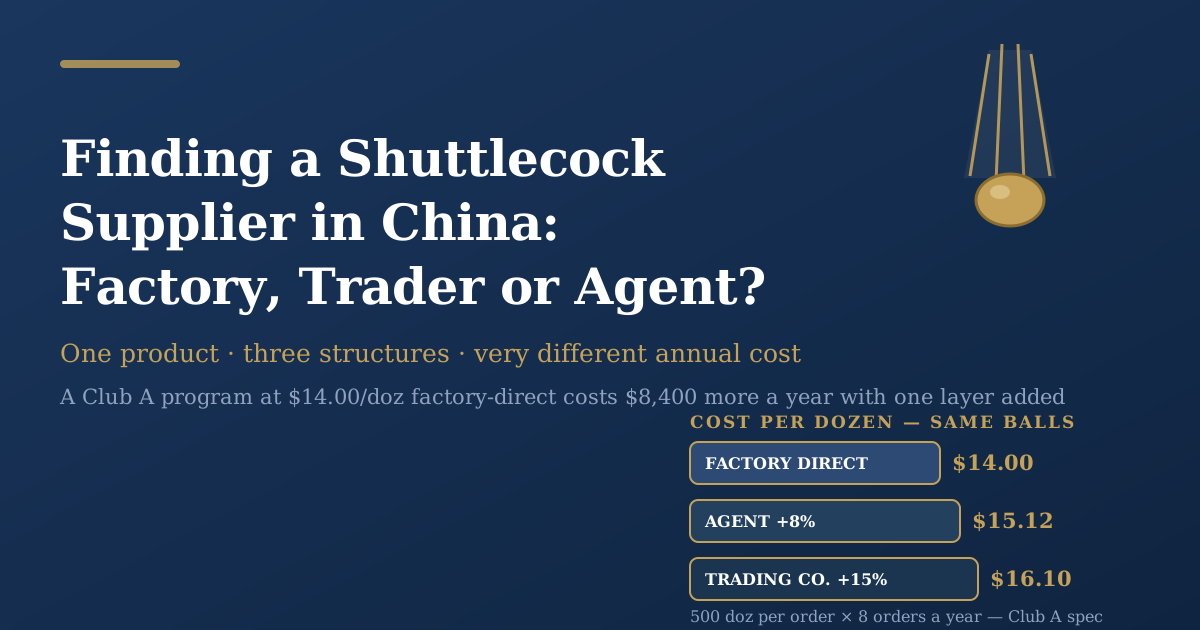
Say the brand orders 500 dozen per order and reorders every six weeks — that is roughly eight orders a year, which is what a healthy club program looks like:
| Route | You pay per dozen | One 500-doz order | Extra per year (8 orders) |
|---|---|---|---|
| Factory direct, FOB | $14.00 | $7,000 | — |
| Sourcing agent at 8% | $15.12 | $7,560 | +$4,480 |
| Trading company at +15% | $16.10 | $8,050 | +$8,400 |
Same balls. Same cartons. Roughly $8,400 a year more at club-grade volumes. Run the same program at Tournament A++ — $26 a dozen, 500 dozen, eight orders — and the trading-company layer costs about $15,600 a year. That is a salary, paid annually, to a phone number that forwards to the factory.
And the markup is only the visible part. If you want to see what the factory-direct number is actually made of — feather at roughly 40% of the cost, cork 14%, labour 17%, tube and carton 13%, margin 16% — we took a wholesale quotation apart line by line here →
When is a middleman worth it? Three honest cases. Mixed small orders under roughly 200 dozen, where factory minimums start to bite. A consolidator who merges your balls with rackets and bags into one LCL shipment. And language or timezone help for a first-time importer who needs hand-holding. If that is your situation, fine — buy the coordination knowingly. Just get the underlying factory's name and location in writing, because the day will come when you need it.
The hidden cost is not the percentage. It is the distance. On reorder number three, when the flight feels a touch different from the first container, a middleman adds a week of "checking with production" to every question you ask — and I have watched buyers lose a selling season to that week, one email at a time. Here is why reorders drift and how factories hold them →
The Ten-Question Supplier Interview
Before any talk of price, send these ten questions. The shape of the answers tells you more than the quote does, and every real factory will enjoy answering them, because these are the questions we wish buyers asked.
| # | Question | A weak answer | A strong answer |
|---|---|---|---|
| 1 | Can I see the production floor on a live video call? | "Our showroom is very nice, I send photos." | "Give us two hours' notice and we will walk the grading tables live." |
| 2 | Which feather is in this grade — goose or duck, which wing, what age? | "Top quality goose feather, very good." | "Second-cut goose, left wing, twelve-month birds. Here is the grade sheet." |
| 3 | How do you test speed before packing? | "We test everything, don't worry." | "Machine flight test plus a human court check. We keep 76/77/78 — tell me your city first." |
| 4 | Full natural cork or composite, and what density? | "Good cork, very hard." | "Full natural on A grades, three-layer composite on Training B. Density is written on the sheet." |
| 5 | How do you hold humidity before the tubes are sealed? | "Our packaging is very good." | "Climate-controlled storage until sealing. Here is last month's logger record." |
| 6 | What changes between my first order and my third? | "Nothing. Same quality always." | "Your spec is frozen. If a feather lot or glue batch must be substituted, you hear it before shipping." |
| 7 | Can you print the tubes in-house? How many colours? | "We cooperate with a printing partner." | "In-house, up to four colours, plates cut once and reused on every reorder." |
| 8 | What do you pull off the line before the carton is sealed? | "Everything is perfect." | "Weight-sorted to ±0.1 g, flight machine on a sample of every batch, weak feathers culled by hand." |
| 9 | Can you send a spec sheet from a previous run, redacted? | "We don't share client information." (fair) — followed by no sheet existing (not fair) | "Here is a redacted one. Yours will look exactly like this." |
| 10 | What is the MOQ for a first order, and what happens at reorder? | "Whatever you want!" | "500 dozen for custom print, 50–100 dozen trial on a stock spec. Reorders keep the same spec sheet." |
Question six is the one that sorts the field. A factory that runs OEM properly keeps a frozen spec sheet per client — feather grade and wing side, cork type and density, glue weight, speed window, tube colour — and has a change-management habit: if a feather lot or a glue batch must be substituted, you hear it before the container sails, not after it lands. A supplier who never wrote your spec down cannot hold it. They can only re-improvise it every order, which is the root cause of most "our second order feels different" emails. Here is how to lock a spec so this never happens to you →
Why the First Order Proves Almost Nothing
Here is the uncomfortable truth about evaluating a supplier: the first order is the least informative one you will ever place. Everyone's best work goes into a first run — the senior grader, the freshest feather lot, the careful packing, the boss personally watching the container get loaded. The real test arrives at reorder two and three, in weeks five through eight, when the feather market has moved and your order is squeezed between two bigger clients' production runs.
Feather supply is agricultural; lots rotate through the year. Cork lots vary in density. Glue batches vary by a gram or two per hundred. A factory worth its MOQ absorbs all of that inside your frozen spec. What should never move: feather grade and wing, cork spec, glue weight, the speed window, and your tube's Pantone. When any of those drift, you feel it in the hall before you see it on paper — and warehouse humidity in the weeks before sealing is one of the usual suspects. Here is what 24/7 climate control actually costs, and why it matters to your container →
So test through two reorders, not one delivery. Keep the second order small, the same way your trial was small, and blind-test it against what is left of the first batch. Two clean reorders tell you more than any certificate framed on a wall — and they take eight weeks, not a day.
One Supplier or Two: the Ball-and-Tube Split
Most brand owners I talk to buy balls from one factory and printed tubes from another, usually because that is how they started and nobody showed them the alternative. The split costs more than it looks: two production schedules that never quite line up, two colour systems that never quite match, and freight that waits for whichever factory is slower. In our experience the split adds 15–25 days to every cycle, because the tubes cannot start printing until the ball spec is final, and the container cannot close until both are done.
When the balls and the tubes come off the same floor, the tube prints while the feathers are still being sorted. The Pantone match is guaranteed by default, because both colours come from the same ink lot and the same press. One schedule, one inspection, one container. On volume: a 20ft container swallows roughly 12,500–13,000 dozen — the constraint is carton cube, not weight — and a single-supplier load plans on one page instead of two. Here is the full 20ft loading and landed-cost checklist →
Five Things That Make Me Slow Down
I will close with the checklist from my side of the table — the things that make me slow down when I watch a buyer about to choose a supplier. None of these prove anyone is dishonest. They prove the structure cannot hold a spec, and it is the buyer's job to catch that before the deposit, not after.
- The quote arrives without asking your speed. A factory that does not ask your city, altitude and season before quoting is planning to ship whatever is convenient. Speed 77 at sea level is a different product from speed 78 in Nairobi — and the buyer who never specced it owns the miss.
- "Any grade you want" — and no grading sheet. Grading is the core skill of this industry. If the grade is not defined on paper — feather, wing, age, cut — it is not held; it is improvised per order, and nobody can hold an improvisation steady for a year.
- No live video from the floor, ever. Showroom photos are marketing. A live walk past the grading tables at 9 a.m. their time is evidence. Suppliers who cannot ever do it are telling you something about who actually holds the machines.
- The MOQ story changes by the day. If their own pages and their own replies cannot agree whether the minimum is 50 dozen or 500 tubes, imagine the consistency of everything else they promise. Here is what realistic MOQs look like, and how to structure a first order →
- The numbers do not multiply. Public listings hand you everything you need to check: 12 balls per tube, 50 tubes per carton, a carton around 67×35×41 cm and roughly 11.5 kg. If a supplier's own carton math does not reconcile, the rest of their numbers will not either.
Frequently Asked Questions
How do I find a real badminton shuttlecock supplier in China?
Start in the feather clusters — Anhui province in eastern China produces much of the world's feather supply, with more factories in Guangdong, Zhejiang and Jiangsu. Shortlist by asking for a live video walk of the production floor, capacity in dozens per year, and answers to the ten questions above. Then run a 50–100 dozen trial on a stock spec before committing to custom print.
What do shuttlecock suppliers charge per dozen in 2026?
Factory-direct FOB bands: Tournament A++ goose $24–32, Match A+ $18–24, Club A $12–18, Training B $7–12 per dozen. Add 5–10% if an agent manages the order, or 10–20% if a trading company sits in the middle. Quotes far below the band are quoting a lower grade, not a better deal.
Is it better to buy from a factory or a trading company?
For anything above a small trial, factory direct wins on price, spec control and reorder speed. A trading company can earn its markup on tiny mixed LCL orders and freight consolidation. Decide with the annual math on your real volumes, not with the first quotation.
What MOQ should I expect from a shuttlecock supplier?
Custom-printed OEM typically starts around 500 dozen; stock-spec trials can run 50–100 dozen. If a supplier claims almost no minimum for full custom work, the printing is being subcontracted — ask who holds your plates and who owns your spec.
How long should I test a new supplier before moving volume?
Through the second reorder — roughly eight to twelve weeks from trial to verdict. The first order shows competence. The second shows consistency, and consistency is the thing you are actually buying.
Bottom Line
Choosing a shuttlecock supplier in China is not really a choice between companies. It is a choice between structures — the factory, the trader and the agent all want your order, but only one of them can hold your spec in their own hands. Pick the structure first, verify the factory with ten specific questions, run the trial small, and judge nothing until the second reorder lands. Do that, and the supplier question stops being a risk you manage and becomes an advantage your competitors do not have.
And when you shortlist, put one option on the list that removes a whole layer of the problem: a factory that makes the balls and the printed tubes, so there is no second supplier to manage at all. See how our one-stop badminton OEM works →
Sourcing? Talk to the Factory, Not a Layer
Send us your feather grade, cork, speed and monthly volume — or just your current spec sheet. We will quote factory-direct FOB with the landed cost to your port, balls and printed tubes from one floor.
Related: How to Choose a Shuttlecock Manufacturer in China (Audit Checklist) | Shuttlecock MOQ and Trial Orders