I get two kinds of sourcing emails. The first says: "Hi, please send price list." The second says: "We're launching a club-grade feather shuttlecock for the UK market, around 600 dozen to start, here's our tube concept." The second buyer almost always ends up with a better product at a better price — not because they wrote a longer email, but because they sourced like a process instead of a shopping trip.
I've run the factory side of this conversation for over twenty years at our Wuhu plant. Most buyers get this wrong, and it's rarely their fault: almost everything written about sourcing shuttlecocks from China is either a supplier directory or a list of generic tips. Nobody shows you the actual roadmap — what happens week by week, what each stage costs, and where the money and the calendar really go. Let me give you real numbers, from inquiry to first container.
Why Sourcing Shuttlecocks Is Not Like Sourcing Other Sporting Goods
A shuttlecock is a consumable. That single fact changes everything about how you should source it. A racket buyer cares about one order going well; a shuttlecock buyer's business lives or dies on whether order number six matches order number one, every 4–8 weeks, forever. Feather balls burn through fast — clubs and academies reorder monthly, retailers every 6–8 weeks.
So when you source shuttlecocks, you're not sourcing a product. You're sourcing a repeating system: feather supply, grading consistency, speed calibration, tube printing, and a factory that can hold all of it steady for years. That's why the roadmap below spends more time on verification and trial orders than on price negotiation. The price is the easy part. The repeatability is the whole game.
Choose Your Sourcing Channel First — It Determines Everything After
There are three ways buyers find us, and each one starts the relationship in a different place:
| Channel | What you actually get | Who it suits |
|---|---|---|
| B2B marketplaces | Hundreds of listings, mostly trading companies mixed with factories; price ranges that often aren't quotable | Initial price comparison, comparing spec language |
| Trade fairs (Canton Fair, Sport Show) | Face time, physical samples, and you can judge who answers questions honestly | Buyers placing 2,000+ dozen or building a long-term program |
| Direct outreach to a factory | One conversation with the people who run the sorting line; quotes come back on your actual spec | Almost every serious buyer, once they know what to ask |
My honest take: use marketplaces for research, then go direct. The listing price on a marketplace is rarely the price you'll pay, because shuttlecock quotes move with feather type, grade, cork and tube design. Two listings that both say "goose feather A grade" can be 3x apart in reality. The channel matters less than the questions you ask once you're in contact. Here's the factory audit checklist I'd use to filter who's worth the conversation →
The Sourcing Roadmap, Week by Week
Here's the timeline that a normal first-time sourcing project actually follows. I've written it the way it happens at our factory, and it matches what serious buyers experience across the industry:
| Week | Stage | What happens | What it costs you |
|---|---|---|---|
| Week 1 | Inquiry & spec sheet | You send feather type, grade, cork, speed range, tube concept, target quantity. Factories reply with questions — the good ones ask a lot. | Free |
| Week 1–2 | Quotation | A real quote on your spec, FOB, with tube printing priced separately from the ball | Free |
| Week 2–3 | Samples | Spec-matched samples shipped; you test flight, durability, speed against your market's conditions | Sample fees from $3–15 per dozen plus courier, often credited on first order |
| Week 4–5 | Trial order | 200–500 dozen, real packaging, real plates cut | Trial budget — this is where most of your risk gets retired |
| Week 6–9 | Trial production & QC | Production runs 30–45 days for a first custom order; you run 5 tests before paying the balance | 30% deposit typical |
| Week 10–14 | Shipping & landing | Sea freight 25–40 days door to door depending on destination | Freight + duties |
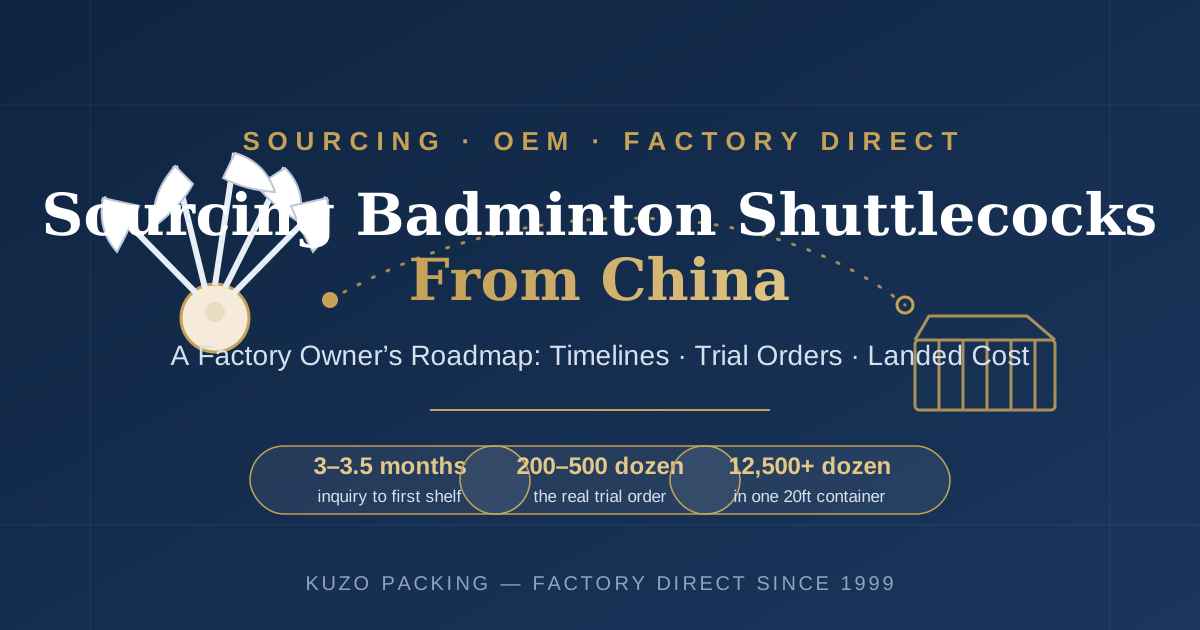
Count it up and a disciplined first sourcing run takes about three to three-and-a-half months, inquiry to products on your shelf. Buyers who skip the trial order to "save a month" almost always lose more than a month fixing what the trial would have caught. Here's how MOQs and trial orders actually work →
What to Put in the First Email (So the Quote Means Something)
Most buyers get this wrong: they ask "price for goose feather shuttlecock?" and receive a number that's meaningless, because the factory had to guess five variables. A quotable inquiry has six things in it:
- Feather type and grade — goose or duck, and the grade band. This is 60–70% of the cost. "Premium" is not a grade.
- Cork — full natural, composite, or three-layer. Changes durability and feel more than buyers expect.
- Speed range — 76/77/78, matched to your market's altitude and climate. A UK club order and a Mexico City order should never quote the same speed.
- Quantity — realistic opening volume plus your monthly reorder. Factories price a 600-dozen trial differently than a 5,000-dozen program, and knowing your reorder tells them whether to invest in your tooling seriously.
- Tube design — even a rough concept: 12 per tube, printed, rough color direction.
- Destination port — so the quote lands as FOB plus a freight estimate, not a mystery.
Send those six and you'll get a quotable number back in one round instead of five. The buyers who make factories ask twenty clarifying questions are the ones whose quotes never converge.
The Trial Order: Where Sourcing Is Actually Won or Lost
Every sourcing guide says "order samples first." Samples are necessary but nearly useless on their own, because sample-room balls are made by the best hands in the building. The trial order — a few hundred dozen, made on the actual production line with the actual packaging — is the real test. Here's what a typical trial looks like in numbers:
- Size: 200–500 dozen. Below 200 dozen, factories run it as a special job and it proves nothing about line consistency. Above 500 dozen, you've paid for more risk than a trial needs to carry.
- Cost example: 300 dozen of Club A grade at $12–18 per dozen FOB is $3,600–$5,400. Add printing plates (one-time, reused on every reorder) and freight. Call it a $5,000–$7,000 education.
- What you test: flight stability, durability on real players, speed consistency across tubes, weight tolerance, and the tubes themselves — crushing, cap fit, print registration.
- The pass condition: blind-test the trial against whatever benchmark you have. If your testers can't tell which is which, the spec is locked.
Before paying the balance on any trial, run the five tests that catch the failures cheap ones miss. Here's the pre-payment testing sequence →
Verifying the Factory Before the Trial, Not After
You can verify a shuttlecock factory without flying to China, and you should do it between the quote and the trial. Three checks take one video call and ten minutes of reading:
Ask for a live line walk, not a marketing video. Any real factory will walk you through the sorting hall on a video call, on their schedule, with the line running. What you want to see is feathers being graded by hand and speed testing happening under their own roof. A factory that can grade and calibrate in-house holds consistency; one that buys pre-graded feathers from someone else cannot promise you the same flight twice.
Ask capacity in dozens, and listen to how they answer. Real factories state real numbers without checking — annual output in dozens, headcount on the sorting line, how many grades they sort under their own roof. The largest integrated mills in the feather clusters run into the millions of dozens a year; a focused mid-size plant runs well into six figures monthly. What matters for you is not the absolute number but whether they can absorb your monthly reorder without your order becoming their smallest, most-forgotten line.
Read the quote like a detective. If two factories quote the "same" grade 3x apart, one of them is quoting a different feather. The quote that itemizes — feather cost share, cork, labor, tube, margin — is the one from a factory that knows its own costs. Here's why two identical-looking quotes can differ 3x →
Landed Cost: The Number Your Business Actually Runs On
FOB price is where the negotiation happens; landed cost is where your margin lives. Let me walk one real-shaped example end to end:
Scenario: 600 dozen Club A feather shuttlecocks, FOB Shanghai at $14/dozen = $8,400 goods. As LCL (less than container) freight to a Northern European port, freight plus handling on this volume typically adds 10–14%, and duties add whatever your tariff schedule says. Landed, you're at roughly $9.50–$9.90 per dozen all-in — call it a 13–15% uplift over FOB on an LCL shipment.
Same goods in a 20ft container: a 20ft container holds roughly 12,500–13,000 dozen of shuttlecocks in standard 12-ball tubes and master cartons — the constraint is volume, not weight, because shuttlecocks are light and bulky. Spread the freight across that volume and the uplift over FOB drops to around 8–10%. That's the entire freight economics of this product: the bigger the box, the smaller the percentage, and there is no weight penalty to fear.
So the sourcing question underneath every price conversation is: how fast do I sell 12,500 dozen? If the answer is "in about 4–6 months," a shared container or a consolidated order with your other SKUs gets you most of the way to full-container economics. If you sell tubes alongside the balls — and you should, because that's where branding lives — consolidate both into the same container and the math improves again. Here's the full first-container checklist with the loading math →
Ball and Tube From One Roof: The Structural Shortcut
The last structural decision in your sourcing plan is whether shuttlecocks and printed tubes come from one factory or two. Most buyers source them separately because that's how the industry was organized twenty years ago. It costs them in three currencies at once:
- Time: two production schedules, two QC handoffs, two shipments to reconcile. Running tubes and balls under one roof shortens the whole timeline by 15–25 days, because the tube prints while the feathers sort and nothing waits on a second factory.
- Color: your brand color on the tube either matches the print the factory controls, or it matches two suppliers' interpretation of the same Pantone number. One roof means one match, guaranteed by default.
- Accountability: when a ball sits loose in a tube, one factory owns the fix. Two factories own a dispute.
The Five Mistakes I See First-Time Sourcing Buyers Make
- Sourcing on price alone. The cheapest goose-feather quote is always a cheaper feather wearing the same words. Compare quotes on an identical written spec or don't compare them at all.
- Skipping the trial because samples looked good. Sample-room balls are showroom balls. The production line is the truth, and only a trial order shows it to you.
- Not writing the spec into the purchase order. "Same as last time" is not a spec. Feather, grade, cork, speed, weight tolerance, tube — in the PO, every order, forever.
- Ordering speed for their home city instead of their market. A 77-speed ball that flies perfectly in Anhui arrives feeling wrong in Nairobi. Match speed to where the shuttlecock will be played, not where it's bought.
- Planning the reorder after the first sale. Your reorder lands 60–75 days after you place it. If your trial proves the product in month three, your reorder should be placed before the trial container even sells through — the buyers who map this calendar from day one never run out of stock.
Frequently Asked Questions
How long does sourcing shuttlecocks from China take the first time?
Plan for 3 to 3.5 months from first inquiry to products on your shelf: 1–2 weeks to quote, 1–2 weeks for samples, 2 weeks to decide, then a 30–45 day trial production and 25–40 days of sea freight. Every stage you skip tends to come back as a delay later, so the disciplined path is usually also the fastest one.
What MOQ should I expect when sourcing from a factory?
Stock-spec orders can start around 50 dozen. Custom grading, custom printing and branded tubes typically start around 200–500 dozen, with trial orders in that band being the norm. Ask for the MOQ on your spec — MOQs move with how much customization you need, not just with the factory's size.
How do I know a supplier is a real factory and not a trading company?
Ask for a live video walk of the sorting and speed-testing lines, ask capacity in dozens and how many grades they sort in-house, and check whether the quote itemizes feather, cork, labor and tube. Trading companies relay questions; factories answer them from the line.
What does a trial order actually cost?
A 300-dozen trial of a mid-grade feather ball at $12–18/dozen FOB runs $3,600–$5,400 plus one-time printing plates and freight — call it $5,000–$7,000 all-in. Sample fees are usually credited against the first bulk order, so ask.
How many shuttlecocks fit in a 20ft container?
Roughly 12,500–13,000 dozen in standard 12-ball tubes and master cartons. Shuttlecocks are volume-constrained, not weight-constrained, so full containers are the cheapest way per dozen to move them — the uplift over FOB drops to around 8–10% versus 13–15% on LCL.
Bottom Line
Sourcing shuttlecocks from China is a three-month project with a ten-year payoff — if you treat it as a process. Pick your channel, write a six-point inquiry, verify the factory on a live line walk, run a real trial order, and do the landed-cost math before you fall in love with an FOB number. The buyers who follow that roadmap end up with the thing that actually compounds in this business: a reorder that lands feeling exactly like the first container, every 4–8 weeks, for years.
And if you want the structural version of that shortcut, source the ball and the tube from the same roof — one spec, one color system, one container, and 15–25 days back on every order you'll ever place. See how our one-stop badminton OEM works →
Send us your six-point spec — feather, grade, cork, speed, quantity, destination — and we'll come back with a quotation on your actual spec and a landed-cost estimate to your port, balls and printed tubes together.
Starting Your Sourcing Run?
Tell us your market, your opening volume and your tube concept. We'll quote on a written spec, show the landed-cost math to your port, and structure a trial order that retires your risk before the container does.
Related: Your First Container Order: 20ft Load & Landed Cost Checklist | Shuttlecock MOQ & Trial Orders Explained