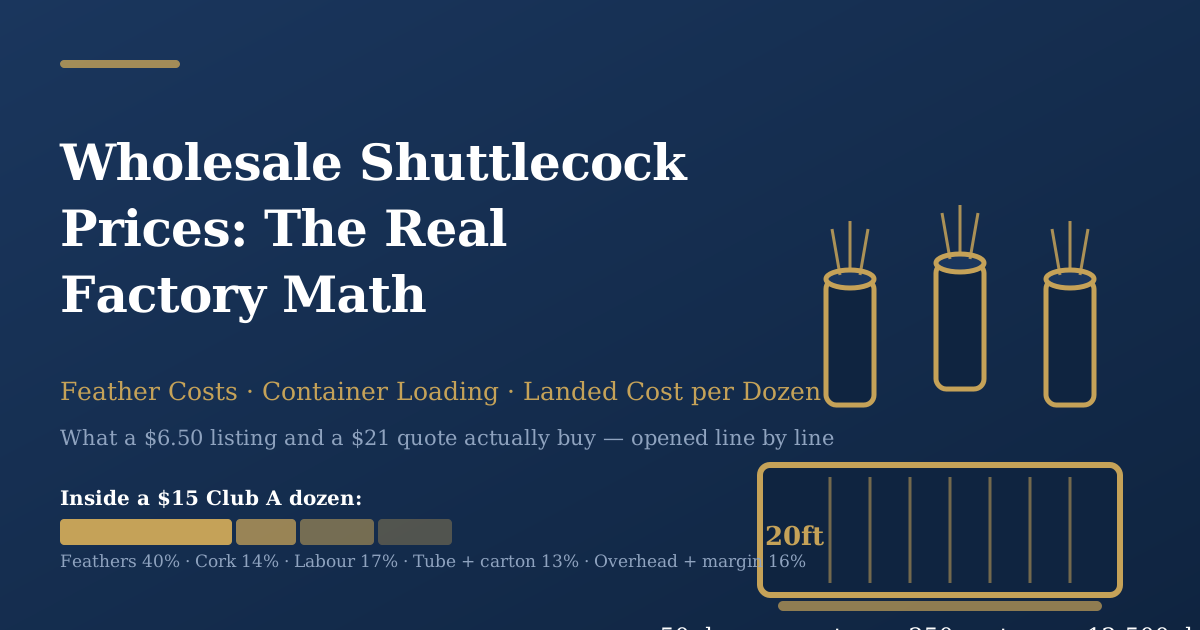
Last month a wholesaler in Spain emailed me two numbers and one question. The numbers: $6.50 a dozen from a B2B directory listing, and $21 a dozen from our sheet for the Club A grade he said he wanted. The question: "Why is your price three times higher for the same thing?"
It wasn't the same thing. But here's the uncomfortable part — both numbers were honest. The $6.50 listing was a D-grade duck feather ball on a wood-composite head, plain tube included. Our $21 was a duck-feather club ball on a composite cork head with the buyer's printed tube and carton mark built in. Same word on the page — "shuttlecock" — different product underneath.
I've run shuttlecock production in Wuhu for over two decades, and I've watched wholesale buyers fall into the same trap more than any other: comparing prices before comparing what sits inside the price. So in this piece I want to open our books the way I do in the factory office when a serious buyer visits — feather by feather, carton by carton. What a wholesale FOB quote actually contains, what volume discounts really do, how many dozen fit in a 20ft container, and what each dozen costs by the time it reaches your warehouse.
Why Wholesale Shuttlecock Prices Range From $6 to $30 a Dozen
Scan any B2B directory for wholesale badminton shuttlecocks and you'll see everything from roughly $2.50 to over $30 a dozen. Some of that spread is margin games. Most of it is construction. A dozen shuttlecocks is 192 feathers — 16 per ball — and what those feathers are (goose or duck, which wing, which age, how tightly sorted) moves the price more than every other component combined.
Here's the part directory pages never explain: grade names are not standardized across factories. One factory's "A-grade" duck can sit somewhere between another's B and C. When I cross-checked live listings while writing this, one large Anhui maker was quoting $13.70 a dozen for a duck-feather practice ball, while a smaller neighbour listed $6.50 for what it called a "Class A duck" — both described as training grade. A third showed tournament goose at $24–30. All three pages used the word "grade". None of them published what the grade meant in feather terms.
So the $6.50-to-$30 spread is not one product with different markups. It's a ladder of different constructions wearing the same word. A wholesale buyer who anchors on the per-dozen number — instead of asking what's inside it — ends up comparing a ladder to a ladder made of different wood. Most buyers get this wrong on their first China order, and it isn't carelessness; the industry simply doesn't publish the construction. Let me publish ours.
What a Wholesale FOB Price Actually Contains
Our four feather grades, with the FOB ranges we quote per dozen (no nylon line in our price list — we only build feather):
| Grade | Feather | Cork head | Typical FOB / dozen |
|---|---|---|---|
| Tournament A++ | Premium goose | Full natural cork | $24–32 |
| Match A+ | Goose | Natural / composite | $18–24 |
| Club A | Duck or lower-grade goose | Composite cork | $12–18 |
| Training B | Duck | Wood-composite | $7–12 |
Now let me cut a $15.00 Club A dozen open the way it actually looks on our cost sheet:
| Cost item | Share of price | Per dozen |
|---|---|---|
| Feathers (192 pcs, sorted duck) | 40% | $6.00 |
| Cork head (composite) | 14% | $2.10 |
| Labour (grading, gluing, speed testing, packing) | 17% | $2.55 |
| Tube + caps + label | 9% | $1.35 |
| Carton + liner + humidity pack | 4% | $0.55 |
| Factory overhead + margin | 16% | $2.45 |
Two things jump out once you see this table. First, feathers plus cork are 54% of the price — and both are raw materials whose prices follow the farm and harvest cycle, not your order size. Second, on an $8.50 Training B dozen the proportions flip: the feather share drops to about 34% while the tube and carton together climb past 21%. Cheap balls are proportionally more packaging and labour, which is why "use a lighter tube" saves more on a $8.50 ball than on a $15 one.
This table is also the honest answer to the Spain email. The $6.50 listing was buying row three of a different construction — thinner feathers, a lighter head, a plain tube. Nobody was lying. The constructions were just different products. Here's my longer walkthrough of reading a factory quotation line by line →
The Volume Discount Truth (Real Numbers From Live Listings)
Every wholesale buyer asks the same question: "What's the price at container volume?" They expect the ladder to fall away steeply. Here's a public data point that shows how steep it actually is.
A large Anhui manufacturer publishes its practice-grade duck ball openly: $13.70 per dozen at 50–299 dozen, $13.40 at 300–999 dozen, $13.00 from 1,000 dozen up. Read that again. Going from a trial quantity to the kind of volume that fills most of a 20ft container saves about 5%. That's the whole ladder, published by a factory with hundreds of staff — not a small shop hiding margin.
The reason sits in the cost table above. If roughly half the price is feathers and cork, and those materials cost the factory the same whether you buy 50 dozen or 5,000, there simply isn't much room to give back. Feathers are an agricultural product — bought at harvest, stored by the tonne, priced by the kilo. Your order size doesn't change the duck.
What does change with volume is a short list, and it's worth knowing because it's where the real negotiable money lives:
- Printing plate amortization. A single-colour tube printing plate costs us about $120, cut once and reused on every reorder for roughly 18 months. Spread across a 300-tube order, that's $0.40 on every dozen. Spread across 3,000 tubes, it's $0.04. That's a 10x swing in one line item — larger than the unit discount most factories will ever publish.
- Loading efficiency. A full container loads tighter than a partial one: better carton placement, fewer air pockets, and the freight per dozen drops accordingly (numbers below).
- Run efficiency. A longer single-spec run means fewer changeovers between grades, and the labour line gets a little cheaper per dozen.
Here's the mistake I see most: buyers hold a 600-dozen order back for two months trying to "reach container volume" for a bigger discount. Even when the discount lands, it's usually worth $0.40–0.60 a dozen — while the two months of waiting cost them sell-through on product their club customers burn through weekly. Printing the tubes now, with the plate amortized over a smaller run, often pays better than the discount they were chasing.
From FOB to Your Warehouse: Landed Cost per Dozen
FOB is where most quotations stop, and it's the number that misleads most. Let me give you real numbers on both ends of the volume scale — a starter LCL order and a full container — both landing in Hamburg.
Example A: 600 dozen Club A, LCL sea freight. That's 12 cartons, about 1.3 cubic metres — too small for a container, so it ships as groupage:
| Line item | Cost | Per dozen |
|---|---|---|
| FOB value (600 doz × $15.00) | $9,000 | $15.00 |
| Sea freight, LCL + fees | $430 | $0.72 |
| Marine insurance | $28 | $0.05 |
| Customs clearance + inland haulage | $310 | $0.52 |
| Import duty (assume 5%) | $450 | $0.75 |
| Landed cost | $10,218 | $17.03 |
Example B: 12,500 dozen Training B, full 20ft container. Same route, full load:
| Line item | Cost | Per dozen |
|---|---|---|
| FOB value (12,500 doz × $8.50) | $106,250 | $8.50 |
| Sea freight, 20ft FCL | $2,750 | $0.22 |
| Marine insurance | $320 | $0.03 |
| Customs clearance + inland haulage | $1,900 | $0.15 |
| Import duty (assume 5%) | $5,310 | $0.42 |
| Landed cost | $116,530 | $9.32 |
Three lessons sit in these two tables. The landed uplift is +13.5% on the small LCL order but +9.7% on the container — freight planning, not unit price, is where volume quietly pays. LCL costs $0.72 a dozen to move while a full container costs $0.22. And duty scales with everything above it, so the same 5% duty on a $27 tournament ball costs three times what it does on $8.50 trainers. When you collect wholesale quotations, ask each factory for the packing data — tubes per carton, cartons per container — so your forwarder can quote freight on real numbers instead of guesses. Here's the full first-container checklist we walk new buyers through →
How Many Dozens Fit in a 20ft Container
Packing standards across Wuhu factories are remarkably consistent, and most publish them: 12 balls per tube, 50 tubes per carton — 50 dozen per carton. Carton sizes cluster around 70 × 37 × 40 cm (about 0.104 cubic metres) or the slightly deeper 55 × 43 × 43 cm box. Run the math on the first one:
- A 20ft container offers about 33 m³ of internal volume; with real-world loading efficiency you actually place roughly 28–29 m³ of cartons.
- 28.5 m³ ÷ 0.104 m³ ≈ 275 cartons theoretical → 275 × 50 = 13,750 dozen on paper.
- Our actual loading plans land at 250–260 cartons, or 12,500–13,000 dozen, because pallets, mixed tube-carton loads and dunnage eat the rest.
- Weight check: 275 cartons × ~12 kg ≈ 3.3 tonnes — nowhere near a 20ft's 21–25 tonne limit. Shuttlecock shipments are always volume-constrained, never weight-constrained.
That last line surprises new buyers. A container of shuttlecocks feels heavy when you're loading it, but the mass is mostly air and paper. Which is why freight per dozen behaves the way it does in the tables above — and why the packing data on your quotation is worth as much as the price itself.
The Cash Flow Math Most Wholesale Buyers Miss
Here's the accounting nobody puts in a listing: shuttlecocks are consumables, and the reorder clock runs faster than most buyers plan for. A club burns through a tube every two or three sessions; our wholesale partners reorder on a 4–8 week cycle. That rhythm should shape how you buy.
I've watched a distributor tie up $40,000 in half a year of stock to "lock the price", then store it through a humid summer in a warehouse without climate control. Feather is hygroscopic — it takes on moisture from the air, and speed drifts with it. The stock that came out of that warehouse did not fly like the stock that went in. Here's what humidity does to shuttlecocks in freight and storage →
There's also a timing problem. Feather prices ran up hard through 2022–2025 and have been easing through 2026, which means big stockpiles bought at the top of the cycle sit next to cheaper fresh stock by autumn. On a falling market, the buyer who rolls 8–10 weeks of cover at a time wins the year against the buyer who filled a warehouse in January. Here's the cost breakdown behind the recent price cycle →
So when a wholesale buyer asks me for our "best price", my honest answer is: the best deal isn't the deepest per-dozen discount — it's the order size that keeps your cash rotating while the balls are still fresh and the market is still moving your way.
How to Compare Wholesale Quotes on the Same Basis
Given everything above, here's the six-point checklist I'd use to put any two wholesale quotations side by side. It takes ten minutes and it's saved buyers from far more expensive lessons than this:
- Pin the feather construction in writing. Goose or duck, wing side, grade number — not "Grade A". One grade step is a 30–40% price move.
- Pin the cork spec. Full natural, composite, or wood-composite. It changes hitting feel and durability more than buyers expect.
- Pin the packing basis. 12 per tube, printed or plain tube, tubes per carton. This single line decides your freight math and your shelf presentation.
- Confirm the Incoterm and port. FOB Shanghai and FOB Ningbo are different freights; EXW is not a wholesale price at all.
- Ask what happens to the plate fee on reorders. A $120 plate amortized over a small first order should not appear again on the second one.
- Convert everything to landed cost per dozen before comparing. FOB differences of $1 a dozen routinely flip sign once freight and duty land.
Frequently Asked Questions
Why do wholesale shuttlecock prices differ so much between suppliers?
Because "grade" names aren't standardized and feather construction drives over half the cost. One factory's $6.50 training ball and another's $13.70 practice ball can both honestly be called duck feather — with different feather density, sorting and cork underneath. Always compare construction, not the word on the price line.
What's a realistic starting MOQ for a wholesale buyer?
Most Wuhu factories open at 50 dozen per grade for a first order, which is one carton-pallet position and enough to run a real market test. We discuss the trial-order logic in detail in our MOQ guide. Here's how trial orders are structured and why factories set 50 dozen →
How much cheaper per dozen at container volume?
On published ladders, about 4–6% between trial quantity and full container — the materials don't discount. The bigger levers at volume are plate amortization on printed tubes, tighter container loading, and freight that drops from roughly $0.72 to $0.22 per dozen.
Do wholesale quotes include tubes and printed packaging?
Usually a plain tube and carton are in the price, but printed tubes may be quoted separately — always ask which basis the quote uses. When balls and printed tubes come from the same factory, the tube prints while feathers are sorted, which shortens the whole timeline by 15–25 days compared to coordinating a separate packaging supplier.
How often should a wholesale buyer reorder?
Plan on a 4–8 week cycle for club and retail demand, and hold 8–10 weeks of cover at a time. That keeps cash rotating, keeps the stock out of long humid storage, and lets you ride the feather price cycle instead of betting a warehouse on one price point.
Bottom Line
The spread between a $6.50 listing and a $21 quote isn't greed — it's construction, plus everything that happens after the balls leave the factory gate. The buyers who source well are the ones who read the cost table the way we write it: feathers and cork first, then the tube, then the freight, then the duty. Compare on that basis and the wholesale price stops being a mystery and becomes a number you can defend to your own customers.
And when you're ready to price a real order, skip the directory listings and ask one factory for the whole picture — balls, printed tubes and the packing data your forwarder needs, in one quotation. That's how our Wuhu factory quotes: custom shuttlecocks and branded tubes from one roof →
Send us your target grade and opening order size, and we'll come back with an FOB quotation, the plate fee amortized over your volume, and a landed-cost estimate to your port — the same math you've just read, applied to your order.
Want This Math Run on Your Order?
Send us your target grade, opening order size and destination port. We'll return an FOB quotation with the plate fee amortized, packing data for your forwarder, and a landed cost per dozen — balls and printed tubes from one factory.
Related: Wholesale Badminton Shuttlecocks From China: A Buyer's Guide | Your First Container Order of Shuttlecocks: 20ft Load & Landed Cost Checklist