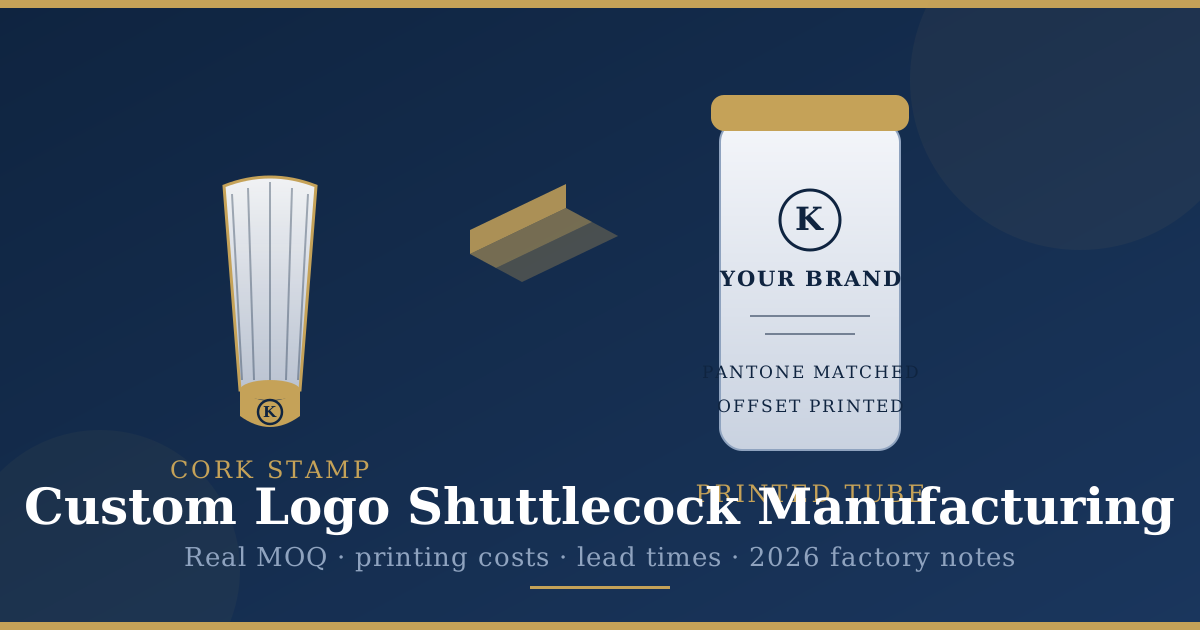
Three or four times a week an email lands in my inbox that goes something like this: "Hi, we are starting a badminton brand. Can you print our logo on shuttlecocks? What is the MOQ?"
I always answer it properly, because that question is exactly the business we built. But I also know from 25 years in this factory that the buyer asking it is usually picturing the wrong thing. They imagine "custom logo" is one service with one price — send a logo, get a ball with a logo on it. Most buyers get this wrong, and the mistake costs them either money they didn't need to spend or a brand look that's weaker than it should have been.
So this is the article I wish I could send instead of a quote. It's the full picture of what a custom logo shuttlecock actually involves from the factory side: where the logo physically goes, what each option costs per dozen, why MOQ exists at all, and how the timeline changes. Real numbers, not brochure lines. By the end you'll be able to read any factory's quotation — including ours — and know exactly what you're paying for.
First: Your Logo Doesn't Go in One Place, It Goes in Four
When a buyer says "logo on the shuttlecock," I have to ask which surface they mean, because there are four separate positions where your brand can live, and they are four different processes with four different costs:
| Position | Process | What it does for the brand |
|---|---|---|
| Cork base of the shuttlecock | Rubber stamp die, inked by hand or machine before assembly | The logo lives on the product — visible every time a player picks up a used ball |
| Shuttlecock tube body | Offset printing on the paper tube (or flexo for simpler designs) | The main branding surface — this is what your customer sees on the shelf and in the club |
| Tube cap | Printed cap or cap sticker | Second touchpoint; cheap way to reinforce colour |
| Outer carton | Carton print or shipping mark | Matters mostly for distributors and retail unboxing |
Here's the part nobody tells a new brand: the cork stamp is the cheapest and most ignored of the four, and it's the one players actually notice. A tube goes in the bin after the balls are used. The cork travels with the ball for its whole life on court. When a club player at your customer's venue picks up a stray shuttlecock and your mark is stamped on the cork, that's the moment your brand becomes a real product instead of a package.
I've seen this play out dozens of times: two brands launch the same season, same grade of ball. One stamps the cork, one doesn't. Eighteen months later the one with the cork mark is the one coaches ask for by name, because their product is identifiable even when it's out of the tube.
What the Logo Actually Costs — Per Dozen, Not Per Promise
Let me give you real numbers. The ball itself is priced by grade, and our FOB prices per dozen run like this: Tournament A++ goose at $24–32, Match A+ goose at $18–24, Club A at $12–18, and Training B at $7–12. Those are the ball numbers, and they're the same whether the ball is branded or not. The logo work prices separately, roughly like this:
| Logo element | One-time cost | Added cost per dozen | Notes |
|---|---|---|---|
| Cork stamp die | $40–80, cut once | $0.10–0.30 | Depends on colours; single-colour marks are the cheap end |
| Tube offset printing plates | $80–150 per design | Already in tube price | Full-colour wrap, Pantone-matched, reused on every reorder |
| Cap sticker / cap print | None (sticker) / small (print) | $0.05–0.15 | Optional; most brands skip it at launch |
| Carton shipping mark | None | ~$0 | Black print on kraft, standard |
Now the interesting bit — the amortisation. A buyer sees "$150 for plates" and flinches. Spread it out instead. On a first order of 500 tubes, that plate is $0.30 per tube. On 2,000 tubes it's $0.075. On the fifth reorder it's zero, because the plate is already on our shelf with your job number on it. I've quoted the same tube design for three years running and the client hasn't paid a cent of tooling since order one. That's the part of the MOQ conversation competitors never explain, so let me do it properly.
The MOQ Math: Why Factories Ask for It and What It Buys You
MOQ is not greed, it's setup time with a number on it. Every custom element in your order forces a changeover somewhere on the floor: the stamp die has to be mounted and inked, the offset press has to be washed down and loaded with your plates and your Pantone inks, the tube winding line changes to your paper stock. Those changeovers cost the same whether the run is 100 tubes or 5,000. Below a certain volume, the setup cost per unit gets silly — for you and for us.
Where competitors land: the listing pages you'll find on the big B2B platforms quote MOQs from 1,000 pieces up to 500 tubes and more, often with no explanation of what the minimum actually covers. Here's ours, with the reasoning attached:
- Custom logo shuttlecock: from 200 dozen for a first logo order. Below that, the stamp changeover and the feather batching stop making sense for either side.
- Custom printed tube: 1,000 units per design, because that's where the offset plate cost per tube stops distorting your price.
- Plain or stock tube: we can go lower, which is how some brands run a soft launch with a stamped cork and a neutral tube first.
And here's the arithmetic most new brands never run. Suppose your launch plan is 300 dozen of a Club A ball at $14 FOB — that's $4,200 of product. The full custom branding package — cork stamp die, tube plates, sampling — adds roughly $250–300 one-time. Your complete "own brand" entry ticket is under $4,600. I've had buyers budget three times that because a quotation they read somewhere implied tooling was a five-figure matter. It isn't. The expensive version of this story is ordering the wrong grade in volume, not paying for a stamp die. Here's how we structure a first trial order →
Pantone: Why One Colour System Beats Two Suppliers
Colour is where custom branding quietly fails, and it's the reason I keep hammering the same-factory point in every article I write. If your shuttlecock comes from one factory and your printed tube from another, your logo now lives in two colour systems. Factory A matches your Pantone 2945C on the cork stamp using their ink supplier. Factory B matches it on the tube using theirs. Both will tell you it's matched. Put the products side by side and one of them is visibly bluer — because paper absorbs ink differently than cork, and because two ink suppliers never mix a shade identically.
When the ball and the tube are made under one roof, that problem disappears by construction. The same Pantone book sits on both lines. The ink for your cork stamp and the ink for your tube print come from the same mixing bench, checked against the same drawdown card. I can walk a visitor from the feather sorting floor to the tube printing line in ninety seconds and show them both running the customer's colour. That's a quality guarantee no amount of email coordination between two suppliers can copy.
The tube side of this — materials, liner, diameter — has its own logic, which I covered in detail in our guide to cork and tube logo printing →
Lead Time: What Logo Work Adds, and What It Takes Away
Buyers always ask whether the logo slows the order down. Honest answer: it adds one stage, and only at the front. The sequence runs like this:
| Stage | Time | What happens |
|---|---|---|
| Artwork check | 1–2 days | We take your vector file, confirm colours and mark size fit the cork and the tube wrap |
| Pre-production sample | 12–15 days | Stamp die cut, plates made, sample dozen produced with your actual logo — couriered to you |
| Sample approval | Your clock | You test flight and check the print. One round is normal; two is fine |
| Bulk production | 30–45 days typical | Ball assembly and tube printing run in parallel on our floor |
That last row is the whole advantage of the one-stop model. A brand ordering balls from Factory A and tubes from Factory B waits for the slower of two independent schedules, then waits again for the two shipments to meet up — usually at the buyer's freight forwarder, with the buyer holding the risk in between. Running both lines in the same building, the tube for your 300 dozen comes off the winder while the feathers are being sorted three rooms away, and the combined timeline comes out 15–25 days shorter than two coordinated factories. I've watched that gap eat into launch windows enough times that I'd treat it as a line item in the plan, not a rounding error. That parallel-lines model is exactly how our Wuhu factory runs badminton OEM →
Three Things Buyers Get Wrong With Custom Logo Orders
Before you send artwork to any factory — us or anyone — run it against these three. Every one of them is a buyer-side spec choice, not a manufacturing problem, and every one of them is fixable before it costs you money.
1. Picking sticker labels to "save" on printing
A pre-made tube with a self-adhesive label looks cheaper on the quotation — the label costs cents. But on the shelf, a wrap of paper with a visible sticker edge reads as exactly what it is. I've watched brands use labels for a first container, then move to direct offset printing on the second reorder and describe it as "finally looking like a brand." The saving per tube was maybe $0.20; the impression cost was the whole first season. If budget forces the choice, keep the label phase short and plan the printed tube into order two.
2. Sending artwork before locking the spec
The logo is the fun part of the order, so buyers send the logo first and leave the spec vague. Then the sample comes back beautiful and the flight isn't what their club players want, and the whole sampling round gets spent again. Lock feather grade, cork and speed first — the logo rides on top of a locked spec, not instead of one. Our grade guide shows how the four grades map to markets →
3. Sending a screenshot instead of a vector file
A rubber stamp die and an offset plate are both cut from your artwork. A 200-pixel screenshot gives the die maker a fuzzy edge, and the fuzz is faithfully reproduced on several thousand cork bases. Send an AI, PDF, EPS or high-res SVG. If all you have is a JPEG, tell us upfront — redrawing a simple mark takes our designer a day and costs nothing near what a re-cut die costs.
A Worked Example: A 300-Dozen Club Ball, Branded End to End
Let me put the whole thing together the way I'd sketch it on paper for a buyer sitting in our office. Target: a club-level ball for a European distributor, speed 77, goose Club A.
- Ball: 300 dozen Club A at $14/dozen FOB = $4,200
- Cork stamp: die $60 one-time + $0.20/dozen = $60 + $60 = $120
- Tube: 300 dozen = 300 tubes at $0.85 offset-printed = $255, plus plate $120 one-time
- Branding total: $240 one-time + $60 per-dozen-consumables — call it 5.2% on top of the product cost
- Timeline: 15 days sampling + 38 days production = 53 days to ex-factory
- Freight sense: 300 dozen packs about 25–28 cartons of 50 tubes — LCL territory. Once the reorder passes roughly 12,000–15,000 dozen you're inside a 20ft container, which is where landed cost per dozen drops another step.
The per-dozen branding cost is the number buyers overestimate and the one-time tooling is the number they underestimate. Once you see both on one page, "can you print my logo" becomes a purchasing decision instead of a hope. For the container-scale version of this arithmetic, here's the full 20ft load and landed-cost checklist →
Why Nobody Else Puts These Numbers Online
Look around at the pages ranking for this topic and you'll notice a pattern. The platform listings give you an MOQ and a photo. The factory landing pages give you a form. None of them will tell you what the cork stamp adds per dozen, because publishing numbers invites comparison — and comparison is exactly what a real manufacturer should want, provided the numbers are on a spec the buyer can actually hold us to. That's the difference between selling a listing and selling from the factory floor. I'd rather you arrive at our quotation already knowing what each line costs than have to work it out line by line after you've committed.
Frequently Asked Questions
What is the MOQ for custom logo shuttlecocks?
Our starting point is 200 dozen for a first logo order, with the cork stamp die and tube plates quoted as one-time tooling. Some platform listings quote 1,000 pieces or 500 tubes without explaining what the minimum covers — always ask whether the MOQ includes the tooling cost amortisation or leaves it as a separate invoice line.
How much does it cost to put my logo on a shuttlecock?
The ball price is set by grade — our FOB runs $7–12/dozen for Training B up to $24–32 for Tournament A++. Logo work adds roughly $0.10–0.30 per dozen for the cork stamp plus a one-time die of $40–80, and $80–150 one-time for tube printing plates already built into the tube price. On a typical first order, full custom branding adds around 5–6% to product cost.
Can you match my exact brand colours on both the cork and the tube?
Yes, and this is where one factory beats two. The cork stamp ink and the tube offset ink are mixed on the same bench against the same Pantone drawdown card, so the mark on the cork base and the wrap on the tube come out in the same shade by default rather than by negotiation.
How long does a custom logo shuttlecock order take?
Count 1–2 days for artwork check, 12–15 days for the pre-production sample, then 30–45 days for bulk after approval. Because shuttlecock assembly and tube printing run in parallel in our building, the combined timeline runs 15–25 days shorter than coordinating a ball factory and a tube factory separately.
Do I need a new stamp die and plates for every reorder?
No. The die and plates are cut once and stored against your job number. Unless you change the logo, the tube design or the colours, every reorder after the first carries zero tooling cost — which is why a larger, well-planned first order amortises the tooling faster than a series of tiny ones.
Bottom Line
A custom logo shuttlecock is four branding surfaces, two one-time tooling items and one parallel production line — and every one of those has a number attached. The cork stamp costs about as much as a takeaway lunch and is the most underused branding surface in the sport. The plate fee looks scary on quote one and vanishes by reorder three. And the single biggest cost lever isn't the logo at all — it's whether your ball and your tube come from the same colour system or two of them.
Send us your logo (vector if you have it), the grade and speed you're targeting, and your opening order size. We'll come back with a quotation that shows the ball, the stamp, the tube and the tooling as separate lines — plus a landed-cost estimate to your port, so the whole decision fits on one page. Start from our one-stop badminton OEM page →
Related: Custom Badminton Logo Printing: Cork and Tube Guide | How to Order Custom Printed Shuttlecock Tubes From China
Want Your Logo on the Cork and the Tube?
Send your artwork and target grade — we'll quote the stamp die, plates and per-dozen branding cost as clear separate lines, with a sample dozen in your colours inside two weeks.