Every club secretary, academy manager and tournament organizer asks me the same thing before their first bulk order: "How many shuttlecocks do we actually need?" Not how many tubes look nice on a shelf, but how many will be hit into scrap by the end of the season. Guess low and you run out before finals. Guess high and you tie up cash in tubes that dry out in storage.
In our Wuhu factory we ship shuttlecocks by the container to clubs, schools, distributors and brands. The buyers who get this right treat the shuttlecock as a consumable with a burn rate, not as a box of balls. In this guide I'll give you the same numbers we use when we help a buyer size an order: per match, per court, per session, per month, and per tournament. The figures come from what we see on our own line, from club reorder patterns, and from tournament consumption reports we've collected over the years.
What Counts as a "Match"
Before the numbers mean anything, we need to agree on the unit. In this article a "match" means a best-of-three-games contest to 21 points with rally scoring, which is the standard format for club leagues, school matches and most amateur tournaments. A "game" is one 21-point race. A "session" is one evening or one training block on one court. A "court" is one playing area for roughly two to four hours.
Why does this matter? Because a casual social doubles match might last 15 minutes and use two shuttles, while a competitive singles match can run 45 minutes and burn through a dozen. If you plan by "matches per night" without stating the format, your numbers will be off by 200% or more.
Per-Match Consumption by Playing Level
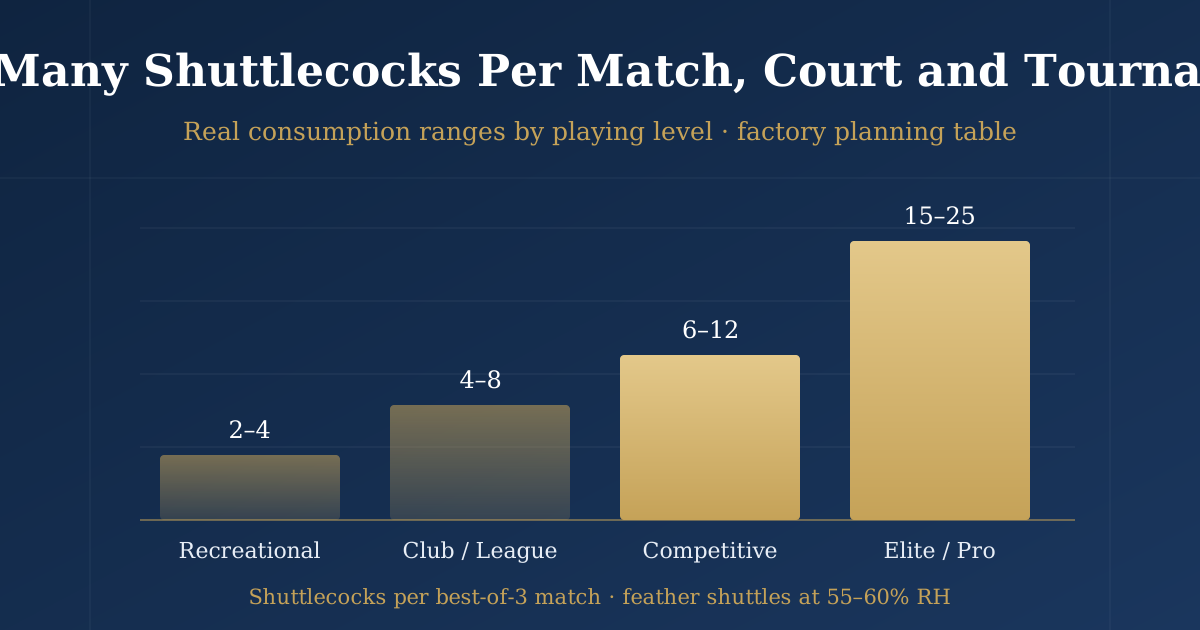
Here is the table I keep on hand when a buyer asks for a quick estimate. The range is wide because smash frequency, player accuracy and hall humidity all change the burn rate. Use the low end for recreational doubles, the high end for hard-hitting competitive singles.
| Playing level | Shuttlecocks per match | Typical game length | What drives consumption |
|---|---|---|---|
| Recreational / social | 2–4 | 15–25 min | Fewer smashes, softer hits, players keep a slightly damaged shuttle in play longer |
| Club / league | 4–8 | 25–40 min | Regular clears and smashes, tighter rallies, shuttles swapped when flight drifts |
| Competitive tournament | 6–12 | 35–55 min | Hard smashes, net play, officials change shuttles at the first sign of instability |
| Elite / professional circuit | 15–25 | 45–75 min | Extreme smash speeds, strict flight standards, shuttles replaced almost every few rallies |
The official tournament planners' reference figure is three to four shuttles per match as a baseline for local events. That is a safe planning minimum, but it assumes average club-level play. If you are running a competitive open tournament, plan for six to eight as your realistic average, and ten to twelve if the draw is strong. I've seen a single elite men's singles match go through an entire tube in two games.
Shuttlecocks Per Court Per Session
Most club and academy buyers do not order for one match. They order for one court on one night, or for a set of courts across a season. The math is simple once you know how many games fit on a court in a session.
A typical club night runs three hours on one court. In that time you can fit roughly six to ten matches depending on whether people play singles or doubles and how quickly they rotate. A competitive training session is different: players may spend half the time on drills and half on match play, so the consumption is more evenly spread across the evening.
| Session type | Games per court | Shuttlecocks per game | Total per court | Tubes needed (12 per tube) |
|---|---|---|---|---|
| Social doubles night | 6–8 | 1.5–2.5 | 9–20 | 1–2 |
| Club league night | 8–12 | 2.5–4 | 20–48 | 2–4 |
| Competitive training | 10–14 | 3–5 | 30–70 | 3–6 |
| Elite practice | 12–16 | 5–8 | 60–128 | 5–11 |
These numbers explain why a 12-court club can burn through a pallet in a month while a school with one court stretches the same volume across a semester. The variable is not the price of the tube; it is the number of hard impacts per hour.
The Tournament Calculator: From Draw Format to Tube Count
Tournament organizers have the hardest planning job because the draw format changes the number of matches dramatically. Here is how to calculate it for the three most common formats.
Single-Elimination Knockout
For a single-elimination draw, the total number of matches is always one less than the number of entries. A 32-player singles draw has 31 matches. A 64-player draw has 63 matches. A 16-pair doubles draw has 15 matches.
Multiply the match count by your expected consumption per match. For a 32-player open tournament at competitive level, using six shuttles per match as a working average:
31 matches x 6 shuttles = 186 shuttles = 15.5 tubes
Add a 15% reserve for warm-ups, broken shuttles in the tube, and extra games that run long. That brings you to about 18 tubes. If the field is stronger or you expect officials to change shuttles more aggressively, use eight per match instead and budget 24 to 25 tubes.
Round-Robin Groups
Round-robin is where consumption jumps. In a group of six players where everyone plays everyone else, there are 15 matches per group. If you have four such groups, that is 60 matches before the knockout stage even starts.
For a 24-player event in four round-robin groups of six, followed by a single-elimination finals stage with four semifinalists:
- Group stage: 4 groups x 15 matches = 60 matches
- Knockout stage: 2 semifinals + 1 final + 1 bronze = 4 matches
- Total: 64 matches
- At 6 shuttles per match: 384 shuttles = 32 tubes
- At 8 shuttles per match: 512 shuttles = 43 tubes
Round-robin guarantees more play per entry, which players love, but it can double your shuttlecock order compared with a knockout-only event of the same size.
Group Stage Plus Knockout
This is the most common format for medium-sized opens. Take 32 players, split them into eight groups of four. Each group plays round-robin, so each group has six matches. The top two from each group advance to a 16-player single-elimination knockout.
- Group stage: 8 groups x 6 matches = 48 matches
- Knockout stage: 16 players = 15 matches
- Total: 63 matches
- At 6 per match: 378 shuttles = 32 tubes
- At 8 per match: 504 shuttles = 42 tubes
Add 10% to 15% reserve and you are ordering 35 to 48 tubes for a 32-player event. If you are supplying shuttles for a multi-day event, keep the reserve on site; a single humid afternoon can push consumption to the high end of the range.
Real Tournament Example: A Four-Day International Circuit Event
To give these numbers a sense of scale, I can share what one four-day European circuit event reported a few years ago. The tournament ran 231 matches across five courts and used roughly 1,740 high-grade shuttles. That works out to about 7.5 shuttles per match, which sits in the upper half of the competitive tournament range.
Why so high? The field was international, the rallies were long, and officials changed shuttles at the first sign of flight drift. That is the difference between a club night and a ranked tournament: in the latter, a shuttle that a social player would keep for ten more rallies gets pulled from play immediately.
Per-Month and Per-Season Budgets for Clubs and Academies
If you run a club or academy, you probably do not order by the match. You order by the season. Here is how to build a season budget from the per-session numbers.
Let us take a medium-sized club with four courts, open three nights a week, for ten months of the year. Each night runs three hours. Assume club-league level play at four shuttles per match, with eight matches per court per night.
- Per court per night: 8 matches x 4 shuttles = 32 shuttles = 2.7 tubes
- Per night across 4 courts: 2.7 tubes x 4 = 10.8 tubes
- Per week (3 nights): 10.8 x 3 = 32.4 tubes
- Per month (4.3 weeks): 32.4 x 4.3 = 139 tubes
- Per 10-month season: 1,390 tubes
That is a rough baseline. If your club runs competitive training on weekends, add another 30% to 50%. If you have a beginner night where players keep shuttles in play longer, you might drop 10% to 15%. The point is not to hit the exact number; it is to move from "order a few boxes and hope" to a number you can defend to the treasurer.
Cost Per Match and Cost Per Season by Grade
Now we can attach factory prices to the consumption numbers. These are our standard FOB per-dozen ranges for feather shuttlecocks. We do not list nylon grades because most of our club and tournament buyers come back to feather after trying synthetics.
| Grade | FOB per dozen | Per-match cost at 6 shuttles | Per-match cost at 10 shuttles | Typical use case |
|---|---|---|---|---|
| Training B | $7–12 | $3.50–6.00 | $5.80–10.00 | Drills, beginner nights, school PE |
| Club A | $12–18 | $6.00–9.00 | $10.00–15.00 | Club leagues, mid-week social play |
| Match A+ | $18–24 | $9.00–12.00 | $15.00–20.00 | Regional opens, academy training |
| Tournament A++ | $24–32 | $12.00–16.00 | $20.00–26.70 | Sanctioned tournaments, finals-grade play |
Look at the per-match cost, not just the tube price. A Training B tube is the cheapest to buy, but if your club plays at a level where shuttles break faster, you may end up opening more tubes and the gap with Club A narrows. Match A+ is often the sweet spot for competitive clubs because the flight holds longer under hard smashes, so you change less often.
For the four-court club in the previous example, a 1,390-tube season would cost roughly:
- Training B: $9,730–16,680 FOB
- Club A: $16,680–25,020 FOB
- Match A+: $25,020–33,360 FOB
- Tournament A++: $33,360–44,480 FOB
Those are factory-door numbers. Add ocean freight, duties and inland delivery to get your landed cost. Here is how we calculate landed cost for a 20-foot container versus an LCL shipment →
Why the Same Grade Burns at Different Rates
Most buyers assume a shuttlecock has a fixed lifespan. It does not. In our line we see the same production batch last 30% longer or shorter depending on what happens after it leaves the factory. Here are the four biggest variables.
Humidity. Feather shuttles are hygroscopic. A tube stored at 25% relative humidity becomes brittle and cracks under the first hard smash. The same tube stored at 55% to 60% RH can last 40% to 60% longer. If your hall is dry, your consumption goes up even if the grade is the same.
Player level. Beginners mishit more, but they also hit softer. Intermediate and advanced players strike the sweet spot more often, but with much more power. The result is usually a net increase in consumption as the level rises, because power eventually wins over accuracy.
Speed selection. A shuttle that is too fast or too slow for the hall gets hit harder and more often out of position, increasing feather stress. The right speed means cleaner rallies and fewer broken feathers. Here is how the grade and speed system maps to what you should actually order →
Storage time. Feather tubes lose moisture over months, especially in air-conditioned warehouses. A tube bought in March and opened in November will behave differently from the same production batch opened in April. We recommend rotating stock and conditioning tubes before high-use periods.
How We Size Orders for Institutional Buyers
When a club, school or academy asks us for a quote, we run through the same five questions every time. The answer gives us a season forecast we can stand behind.
- How many courts, and how many hours per week? This is the base volume we size from.
- What level of play? Recreational, club, competitive or mixed? Mixed sessions need a blended consumption rate.
- What format? Singles burns more shuttles per game than doubles at the same level because the court coverage is wider and rallies can be longer.
- What is the local climate and storage? Dry climates push consumption higher; humid climates are easier on feathers.
- How much reserve do you want? We typically recommend 10% to 15% for clubs and 15% to 20% for tournaments.
We then cross-check the forecast against the buyer's actual reorder history if they have one. Most clubs overestimate their first order by 20% to 30% because they forget that some sessions are lightly attended. A good forecast saves you from a storage room full of dried-out tubes.
Common Ordering Mistakes
These are the patterns I see most often when a buyer gets the number wrong.
- Planning only for match play and forgetting warm-ups. A tournament court usually burns one to two extra shuttles per match during warm-up. Over a 100-match event that is an extra 100 to 200 shuttles.
- Buying on tube price alone. A cheaper grade that breaks twice as fast can cost more per usable game than a mid-grade option. Always run cost-per-game, not cost-per-tube.
- Ordering every month instead of every season. Small, frequent orders mean higher freight cost per dozen and more handling. A single 20-foot container holds roughly 12,500 to 13,000 dozen, and the per-dozen landed cost drops sharply compared to LCL.
- Storing tubes in a hot or dry room. Air-conditioned storage in a dry climate can ruin feathers faster than a cool basement. Humidity control matters more than most buyers think.
- Ignoring the speed chart. The wrong speed increases consumption because players compensate with harder, less controlled hits.
Quick Reference: Order-Size Cheat Sheet
Here is a one-page reference I send to buyers who need a fast answer. Use the low end for social play and the high end for competitive play.
| Scenario | Estimated matches | Consumption assumption | Tubes to order |
|---|---|---|---|
| One social doubles night, 1 court, 3 hours | 6–8 | 2 per match | 1–2 |
| One club league night, 1 court, 3 hours | 8–12 | 4 per match | 3–4 |
| Competitive training, 1 court, 2 hours | 10–14 | 4 per match | 4–5 |
| 32-player knockout tournament | 31 | 6–8 per match + 15% reserve | 18–24 |
| 32-player group-plus-knockout | 63 | 6–8 per match + 15% reserve | 36–48 |
| 4-court club, 3 nights/week, 10 months | ~4,100 | 4 per match | ~1,390 |
Frequently Asked Questions
How many shuttlecocks are needed for one badminton match?
For a best-of-three-games match at club level, plan on four to eight feather shuttlecocks. At recreational level, two to four is usually enough. At competitive tournament level, six to twelve is realistic, and elite matches can use fifteen to twenty-five.
How many shuttlecocks does a badminton court use in one night?
A single court used for three hours burns roughly one to two tubes for social doubles, three to four tubes for club league play, and five to eleven tubes for elite training. The biggest variable is how hard the players hit and how often shuttles are replaced.
How many shuttlecocks are needed for a 32-player tournament?
A single-elimination 32-player tournament has 31 matches. At six shuttles per match plus a 15% reserve, you need about 18 tubes. If the event uses a group stage plus knockout, the total rises to 63 matches and you need roughly 36 to 48 tubes depending on consumption per match.
Do singles and doubles use the same number of shuttlecocks?
No. Singles rallies tend to cover more court and can last longer, so singles matches usually consume more shuttles than doubles at the same level. However, doubles has more smashes per rally, which can also increase wear. Use a slightly higher per-match estimate for singles formats.
How should clubs budget for shuttlecocks per season?
Multiply courts by nights per week by weeks per season by matches per court per night by shuttles per match, then add 10% to 15% reserve. A four-court club playing three nights a week for ten months at club level needs roughly 1,300 to 1,500 tubes per season.
Why does the same grade of shuttlecock last longer in some halls?
Humidity is the main reason. Feathers stay supple at 55% to 60% relative humidity and become brittle below 30%. Storage temperature, hall height and air conditioning also affect how long a shuttle holds its flight.
Is it cheaper to buy more tubes at once?
Yes, up to a point. Freight and handling spread over more tubes lowers the landed cost per dozen. A 20-foot container holds about 12,500 to 13,000 dozen, which is where the per-dozen freight cost drops most sharply for large clubs, academies and distributors.
Bottom Line
The question "how many shuttlecocks do I need?" only looks simple until you account for format, level, climate and draw structure. A club treasurer who guesses wrong either runs short before finals or locks up cash in tubes that degrade in storage. The buyers who get it right build a forecast from the same few variables: courts, hours, level, format and reserve.
If you are a club, academy, school or distributor trying to size a season order, send us those five numbers and the grade you have in mind. We will run the consumption forecast against our factory pricing and give you a landed-cost estimate to your port. Our one-stop badminton OEM covers shuttlecocks and printed tubes from the same factory, which also knocks 15 to 25 days off the lead time →
Stop guessing by the box. Start planning by the match, the court and the season.
Size Your Season Order With Real Factory Numbers
Tell us your courts, weekly hours, player level and target grade. We will calculate your season tube count and quote shuttlecocks plus custom tubes together from one factory.
Related: How Long Do Feather Shuttlecocks Last? | Shuttlecock Quality Grades Explained