I get this question at every trade fair, usually from a brand owner who has just finished the arithmetic on their first season and doesn't like the answer: how long do feather shuttlecocks last, really? Not the marketing answer. The answer that lets them price a tube, forecast a reorder, and explain to a club why one ball costs twice what another one costs.
I've run a shuttlecock line in Wuhu for over twenty years, so let me give you the version I give buyers on a factory call. Almost every page that answers this question is written by a retailer or by a player, and both of them measure the wrong thing. Players measure by feel. Retailers measure by whatever stops the customer asking twice. A factory measures something far less romantic: how many impacts until the flight drifts out of tolerance. That number, not the number of games, is what your business actually runs on.
Why "How Long Does It Last" Is the Wrong Question
A shuttlecock's working life is not a fixed property of the ball. It is the product of four things meeting at once: the feather, the cork, the moisture inside that feather, and the hand holding the racket. Change any one of them and the answer moves, sometimes by a factor of three.
Most buyers get this wrong. They ask a supplier "how many games?" and accept an answer like "two to three." That figure is meaningless on its own, because it has no playing level attached. A ball that gives a recreational pair three comfortable games gives a league doubles pair one. Same ball, same tube, same batch. The ball didn't change. The impact load did.
So the question worth asking is narrower and much more useful: how many hard impacts until the flight drifts out of the speed class it was built for? That is a number a factory can measure, a number you can write into a purchase order, and a number you can convert into games once you know who is swinging the racket.
A Shuttlecock Dies in the Air, Not in Your Hand
The cork is almost never what fails. I've pulled balls off our own scrap line after ugly club sessions where the base was perfectly sound and the skirt had four bent vanes. Structurally whole. Aerodynamically finished.
Each of the sixteen feathers is doing two jobs at once. It is a structural rib holding the cone together, and it is an aerodynamic surface shaping the drag that makes a shuttlecock decelerate the way players expect. Once two or three vanes bend or split unevenly, the drag profile goes asymmetric. The ball starts to wobble, or it drifts a little off the line, and the timing a good player built their whole swing around stops working.
This is why durability has to be judged by usable flight, not by whether the ball still looks intact. It is also the reason two people can play the same tube and disagree completely about how long those balls lasted. One of them was measuring breakage. The other was measuring flight. Only the second one is describing anything a manufacturer can control.
The Number We Actually Test To: Hits to Flight Drift
On our line we don't guess at this. We condition tubes at a controlled humidity, run sample balls through a repeatable impact sequence, and check each one's flight against a fresh control ball from the same batch. The pass condition is not "did it break." It is "does it still land where a fresh one lands."
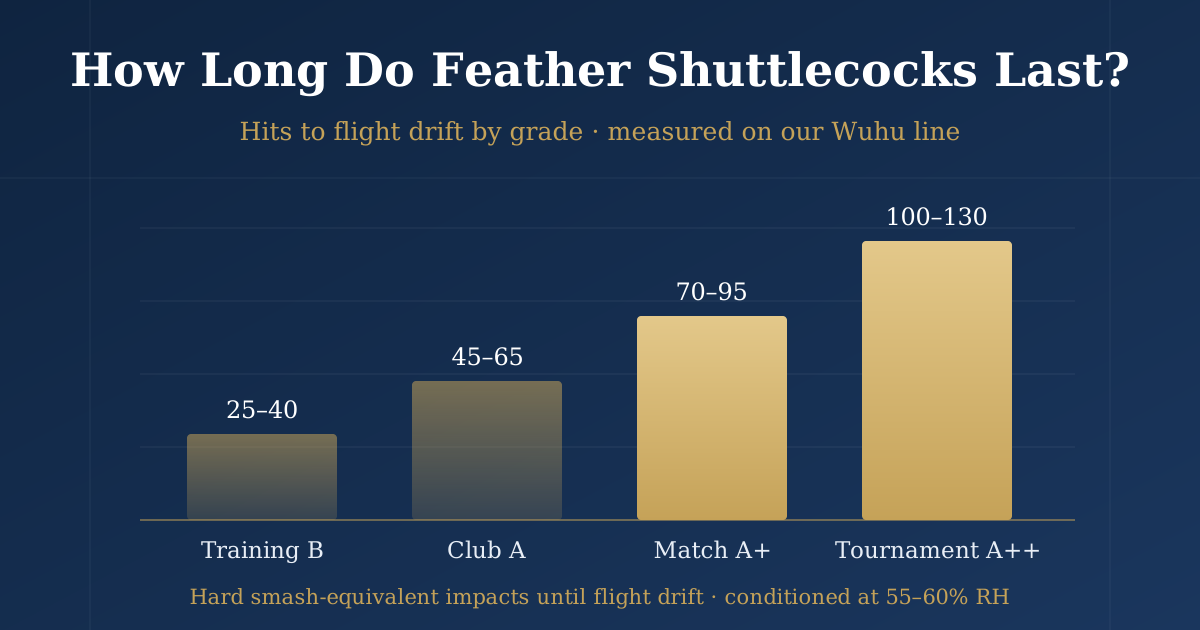
Let me give you real numbers. These are the bands we hold on our four standard grades, expressed as hard smash-equivalent impacts until the ball drifts out of its speed class:
| Grade | Feather | Hits to flight drift | What that looks like in practice |
|---|---|---|---|
| Training B | Duck, thinner vane, wider sorting band | 25–40 | Built for coaching baskets and high-volume beginner use, where balls get hit dozens of times in a single drill |
| Club A | Duck or duck/goose, mid grade | 45–65 | The workhorse for league nights and academy sessions; this is where most club volume sits |
| Match A+ | Goose, grade A, tight vane selection | 70–95 | Competitive club and regional tournament play; holds its line through hard flat exchanges |
| Tournament A++ | Goose, top grade, narrow sorting | 100–130 | Sanctioned play; every ball in the tube sorted and calibrated under one roof |
Read across that table and one thing jumps out: the top grade absorbs roughly four times the punishment of the training ball. That gap is real, and it is where the whole price argument starts, because four times the durability does not cost four times the money. I'll come back to that with real figures below.
The Same Ball Lasts a Different Number of Games at Every Level
Now convert those hits into games. A twenty-one-point game at recreational pace might put thirty to forty meaningful impacts on a ball. A competitive club game puts more, and a tournament doubles game puts far more, because the exchanges are flatter, the smashes are heavier and the ball is being struck at speeds nobody in a social session reaches.
Here is how the same four grades land across three levels. These are honest working ranges, the ones I use when a buyer asks me to help them forecast:
| Grade | Recreational / social | Club / league | Tournament |
|---|---|---|---|
| Training B | 2–3 games | about 1 game | under 1 game |
| Club A | 3–4 games | 1–2 games | about 1 game |
| Match A+ | 4–6 games | 2–3 games | 1–2 games |
| Tournament A++ | 5–7 games | 2–3 games | 1.5–2.5 games |
The pattern is the part that matters: every step up in playing level roughly halves the game count. A training ball that survives three gentle social games is gone inside one league game. If you are supplying a club and you forecast on the recreational column, you will be short on stock by month two.
This is also why speed selection and durability are the same conversation. A ball ordered at the wrong speed for the hall gets hit harder to make it carry, and harder hitting is exactly what ends its life early. Here is how to match speed to your market's climate and altitude →
Humidity: The Variable Nobody Budgets For
Feather carries moisture, and that moisture is the reason a vane flexes on impact instead of cracking. Dry feather doesn't bend. It snaps.
In a hall sitting at 25–30% relative humidity, we see working life drop by roughly half against the identical ball conditioned at 55–60% RH. That is not a rounding error. It is the difference between a club buying four dozen a month and the same club buying eight, and it is the single most common reason a buyer tells me the last batch "felt different" when nothing about the batch changed. Here is what we do about humidity through freight and storage →
The moisture that a feather leaves our building with is not an accident, and it is not permanent either. It can be put back. Which brings us to the one thing a club or an academy can do that changes the answer materially.
Steaming and Conditioning: What It Actually Does
Steaming restores that working moisture. Open the cork end of the tube, hold it over a kettle for fifteen to thirty seconds, close it, and let it sit for a couple of hours. Done properly on a dry tube, it can roughly double working life. Clubs in dry inland climates and in heated winter halls should be doing this before every session.
Done badly it creates its own problem. Over-steam and the cork picks up weight, the ball flies heavy, and the speed number printed on the tube stops meaning anything. Our own rule on the line is the same rule I give buyers: condition to a target, don't soak. A few seconds of steam and a few hours of rest will get you almost all of the benefit with none of the weight gain.
Why the Best Ball Can Feel Like It Dies Fastest
Buyers push back on this constantly. They buy tournament grade expecting it to outlast everything, then a good player tells them it was finished after a game and a half, and they want to know what went wrong on our line.
Nothing went wrong. A tournament ball gets retired the moment its flight drifts, because at that level a two percent drift is the difference between a clean winning return and a shot into the tape. A club ball gets played until it visibly comes apart, because nobody at that level is timing a smash to the centimetre. Both balls reached the end of their working life. Only one of them looked like it.
So the premium ball is not less durable. It is held to a tighter definition of finished. And that cuts the other way too: if you spec A++ for a recreational club programme, you will pay top money to have balls retired early by players who cannot feel the drift in the first place. Match the grade to the level that will actually be hitting it. Here is what each grade band actually contains →
Cost Per Game, Not Cost Per Dozen
This is the piece of arithmetic I walk brand owners through, and it is the one almost nobody publishes, because it needs factory prices and real durability numbers sitting in the same table. Here it is, using our standard FOB bands and club-level play:
| Grade | FOB per dozen | Per shuttle | Games at club level | Cost per usable game |
|---|---|---|---|---|
| Training B | $7–12 | $0.58–1.00 | about 1 | $0.58–1.00 |
| Club A | $12–18 | $1.00–1.50 | 1–2 | $0.50–1.50 |
| Match A+ | $18–24 | $1.50–2.00 | 2–3 | $0.50–1.00 |
| Tournament A++ | $24–32 | $2.00–2.67 | 2–3 | $0.67–1.33 |
Look at where the cheap ball lands. Training B looks like the bargain per dozen and is often the most expensive per game, because it dies inside one game at club level. Match A+ frequently lands at the lowest cost per usable game of the whole range, and it does that while giving the player a noticeably better ball.
Tournament A++ is not bought for economy and should not be justified on it. It is bought for flight precision, for tournament credibility, and for the brand story that comes with supplying sanctioned play. If you are writing a range, that is the halo SKU. The volume and the margin usually live one grade below it.
Then there is the number your business actually runs on, which is not cost per game at all but reorder cadence. Feather is a consumable: clubs and academies come back every four to eight weeks, retailers every six to eight. A grade that lasts twice as long does not halve your customer's spend, but it does change how often they place the order and how they feel about your brand while they wait. Here is the full factory math behind wholesale pricing →
What We Do on the Line to Hold It Steady
Durability that swings from batch to batch is worse for your business than durability that is consistently ordinary. A club that gets three games from every tube forever will forgive you a lot. A club that gets four games one month and one the next will move on, and they will tell you it was the ball that changed even when it wasn't.
Three things hold that number steady, and all three have to happen under one roof:
- Grading in-house. A plant that buys pre-sorted feather from someone else cannot promise you the same vane thickness twice, and vane thickness is durability. We sort under our own roof and we sort into our own grade bands.
- Conditioning before the tube closes. Moisture is set at closing, not at shipping. If it isn't right when the cap goes on, no amount of careful freight will put it back.
- Batch flight testing against a control. Every batch gets flown against a reference ball at the same conditioning, and the drift has to sit inside the band for that grade before the cartons are released.
When you are talking to a factory, ask how many grades they sort themselves and how many they buy in. The answer tells you more about consistency than any certificate on the wall. Here is the sampling and testing sequence to run before a bulk order →
How to Spec the Durability You Actually Want
Durability is not luck. It is a line item on your spec sheet, and you have four levers on it:
- Grade and vane thickness. The biggest lever by far. Everything in the table above flows from this.
- Feather type. Goose carries a thicker, more resilient vane than duck and holds its shape through more impacts. Duck is cheaper and flies well, which is exactly why it dominates training volume. Here is the honest cost comparison →
- Cork. A denser, well-bonded base keeps its shape through repeated compression, and a base that deforms throws the whole assembly off line even when the feathers are fine. Here is how the three cork types compare →
- Speed match to the hall. Wrong speed means harder hitting, and harder hitting means shorter life. This one costs nothing to get right and is the most commonly missed.
Most buyers get this wrong: they spec grade for prestige and never write durability into the purchase order at all. Put it in. Write the expected hits to drift, or the equivalent game count at your target level, into every order alongside feather, cork and speed. "Same as last time" is not a spec, and it is how ranges quietly drift over two years.
If your customers are clubs, academies or schools, durability is the one spec they will actually feel and comment on, which makes it the spec that wins you the second contract. Here is how institutional buyers evaluate a shuttlecock supplier →
The Nylon Question, Answered Honestly
Any honest answer to "how long does it last" has to deal with nylon, because nylon lasts longer and everyone knows it. Let me be clear about something first: nylon is not a bad product. The moulded skirt flies true, the base is sound, and the delivery schedule is reliable. I have no argument with how it is made.
What I have watched happen is on the brand side of the ledger. A good number of the brand owners we work with ran a nylon line for a while, then shrank it and moved back to feather. Not because anything went wrong with the nylon. Because of what it did to their own books.
Feather is a consumable, so the reorder lands every four to eight weeks. Nylon is durable, so the reorder lands every six to twelve months. Those two cadences are an order of magnitude apart, and a brand built on one does not survive being switched to the other without rebuilding its whole cash cycle.
The part I'd call a specification mistake rather than a manufacturing one: those lines were chosen on unit price plus durability, while the people buying them at the counter were choosing on flight feel. Two different axes. The product did what it was designed to do; it was just selected against the wrong measure. Here is the fuller account of why brands came back →
Nylon still earns its place in four situations, and I tell buyers this openly: entry-level coaching where balls take a beating from beginners, school tenders written around a fixed annual budget, very hot or very humid climates where conditioning feather is a constant fight, and market entry where the price point has to be low enough to win the first trial. Treat it as an acquisition SKU. Feather is the retention SKU, and it is where the repeat business lives.
Frequently Asked Questions
How long does a feather shuttlecock last in games?
At club level, roughly one to two games for a mid-grade ball and two to three for a match-grade goose ball. At recreational pace the same balls give three to six games. At tournament level, expect one to two. The spread comes from impact load, not from the ball, which is why any answer without a playing level attached is not much use.
How many shuttlecocks does a club go through in a session?
A four-court club evening running two to three hours typically works through two to four dozen depending on grade and how hard the players hit. That is the number to build a reorder calendar around, not the number of games per ball. Forecast on court hours and you will land much closer than forecasting on games.
Can steaming really double a shuttlecock's life?
On a dry tube, yes, roughly. Fifteen to thirty seconds of steam into the open cork end, then close it and let it rest for a couple of hours. Do not over-steam: a saturated cork gains weight and the ball flies heavy, which defeats the purpose.
Why does the same grade seem to last longer in summer than in winter?
Humidity. Heated winter halls and dry inland climates pull moisture out of the vane, and dry vane cracks instead of flexing. The ball did not change; the air did. Conditioning or light steaming closes most of that gap.
Is the most expensive shuttlecock the most durable?
It takes the most impacts before its flight drifts, yes. But if you judge on cost per usable game, the mid-to-upper grades often beat the top grade at club level, because the top grade is retired at a much tighter drift tolerance than a club player can detect. Buy A++ for flight precision and tournament credibility, not for economy.
How do I make durability consistent across reorders?
Write it into the spec and hold the factory to a band: feather type, grade, vane thickness expectation, cork, speed, and an expected game count at your target level. Then test each batch against a retained reference tube from the previous order. Here is why reorders drift and how to lock them →
Bottom Line
Feather shuttlecocks do not have a lifespan. They have a lifespan at a level, and once you start measuring them that way the whole buying conversation gets simpler. Ask for hits to flight drift rather than games. Match the grade to the level that will actually be hitting it. Budget for humidity, because it moves the number more than anything else you can control after the ball leaves us. And price your range on cost per usable game, not cost per dozen, because that is the arithmetic your customer is doing whether they say so or not.
Get those four right and durability stops being a complaint you manage and becomes the spec that wins you the reorder. See how we build and calibrate feather grades for OEM programmes →
Send us your market, the level your customers play at, and the grade you are considering. We will tell you honestly what to expect from it in games, and whether a grade either side of it serves your customers better.
Speccing a Shuttlecock Range?
Tell us the playing level, the climate and your target price point. We will recommend the grade, quote on a written spec, and tell you what to expect from it in games before you commit to a container.
Related: Shuttlecock Quality Grades: Tournament, Match, Club and Training | What Causes Inconsistent Shuttlecock Flight